Kaiping’s Watchtowers: A Case Study in Diaspora and Identity
The first thing I noticed was the angle.
One of the towers leaned slightly, not enough to alarm an engineer, but enough to make a visitor pause. It rose from flat farmland like a stubborn thought that refused to be edited out. Concrete walls, decorative flourishes that looked borrowed from somewhere far away, and small apertures high up that were clearly not meant for fresh air. The rice fields were quiet. The tower was not.
Standing there, I had the familiar travel impulse: take a photo, note the UNESCO label, and quietly move on. But in Kaiping, speed isn’t your friend.
These watchtower-homes (Diaolou) don’t function like tourist attractions, although that it what the locals are hoping they will become. They are the physical evidence; residue of decisions made under uncertainty: who to trust, what to protect, how to belong after you’ve been reshaped by life abroad.
Kaiping is usually described as a “hidden gem” in Jiangmen, Guangdong. It is a UNESCO World Heritage Site (listed in 2007), and the region contains an extraordinary concentration of Diaolou, built mostly from the late Qing era through the early 20th century. That’s the brochure version. The more useful version is this: Kaiping is a living case study in how systems absorb migration, money, fear, aspiration, and identity, then convert them into built form.

Throughout my travels in Asia, I’m recall Kaiping vividly because it reveals a pattern that shows up across Asia in different disguises: return changes the system. By that, I mean that when people leave a place, they send back new standards, new aesthetics, new risk perceptions, and new social expectations. Over time, that return pressure reshapes local institutions. The Diaolou are the “hard infrastructure” expression of that pressure.
They answer three questions that every community and every organization eventually faces:
What are we defending against?
What signals status and legitimacy here?
How do we maintain continuity while adapting to external influence?
Kaiping answers those questions in concrete. It is tempting to read the Diaolou as architectural novelty: Western columns here, Chinese motifs there, maybe a dome thrown in like an international seasoning packet. That view is shallow.
The Diaolou were designed for defense and visibility, built during periods when local insecurity and banditry were real concerns. Their height offered surveillance. Their gun ports offered deterrence. Their thick walls offered resilience. They were homes firstly, but they were also small-scale security infrastructure.
From a systems perspective, this is what matters: The Towers Encode an “Uncertainty Strategy.” When formal institutions cannot guarantee safety, communities engineer safety. That engineering can look like fortifying homes, centralizing valuables, creating surveillance positions, or signaling deterrence. In modern organizational terms, you could call it: distributed resilience. How’s that for a fancy buzz term?
When I walked through Kaiping, what I was wasn’t a nostalgic village landscape but rather a community that operationalized uncertainty into design decisions.
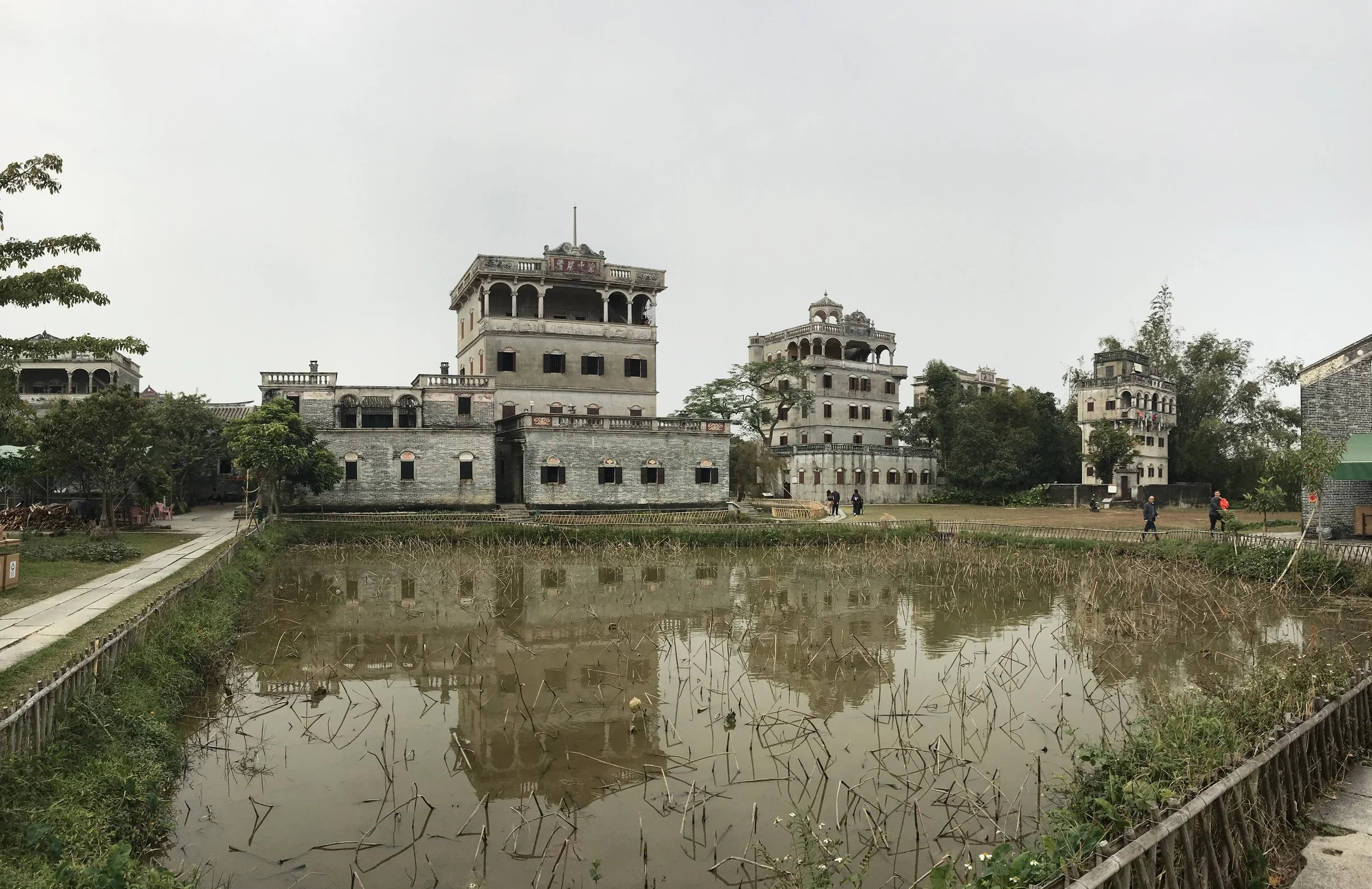
Kaiping’s distinctive blend of Western and Chinese styles is not random. Many Diaolou were funded by overseas Chinese who earned income abroad and sent money back or returned with wealth to build; lending their fingerprint. This is where Kaiping becomes an unusually clean example of cross-cultural systems at work in that external exposure changes personal standards, returning capital changes local power dynamics, and new structures change how the community organizes itself all around.
In Kaiping, the Diaolou function as both:
a practical investment (secure, durable, defensible property)
a social signal (status, cosmopolitanism, modernity)
In plain terms: the tower says, “I have been elsewhere, and I brought something back.”
In a modern Asian city, the “Diaolou equivalent” might be a returnee-founded startup with global norms or a school system redesigned to match foreign benchmarks. Different forms, but the same mechanism: return reshapes the baseline.
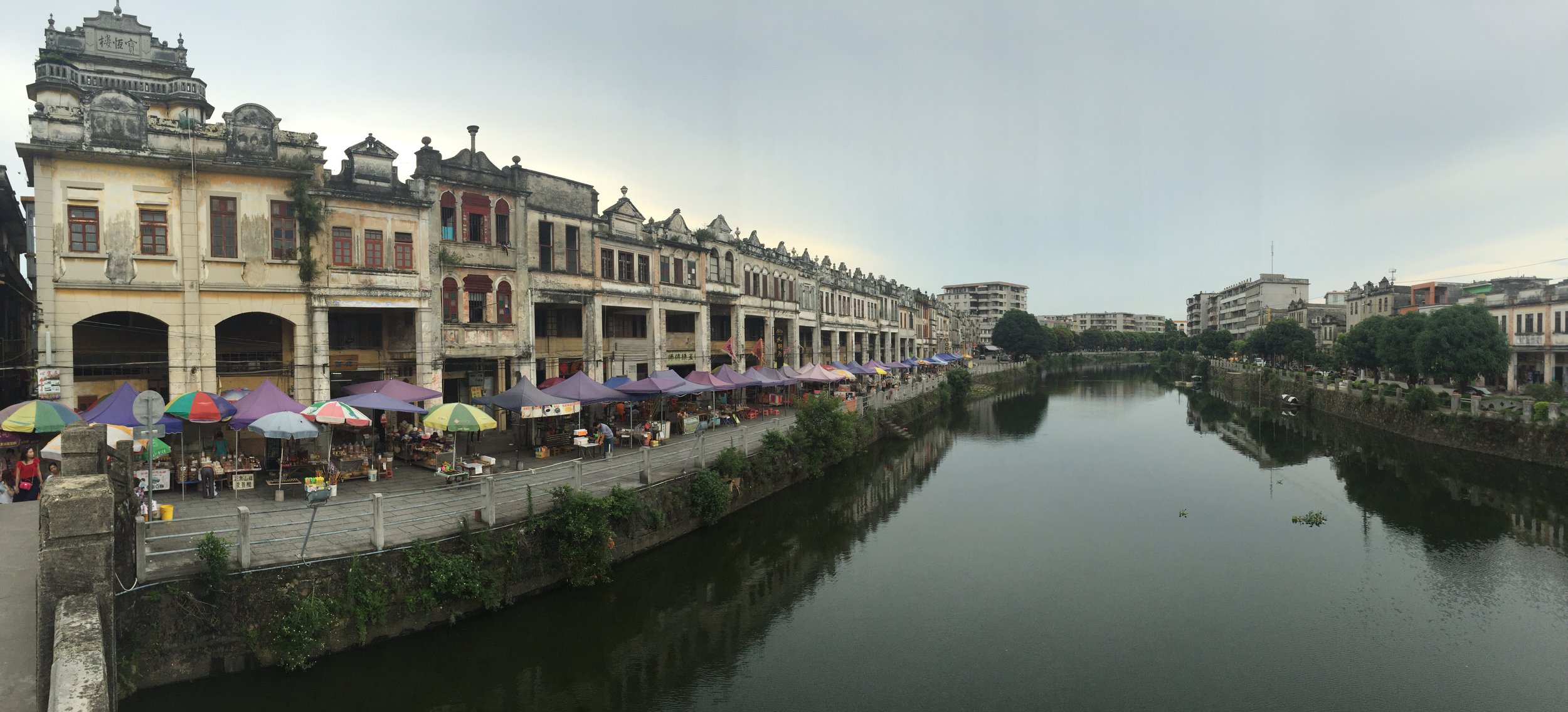
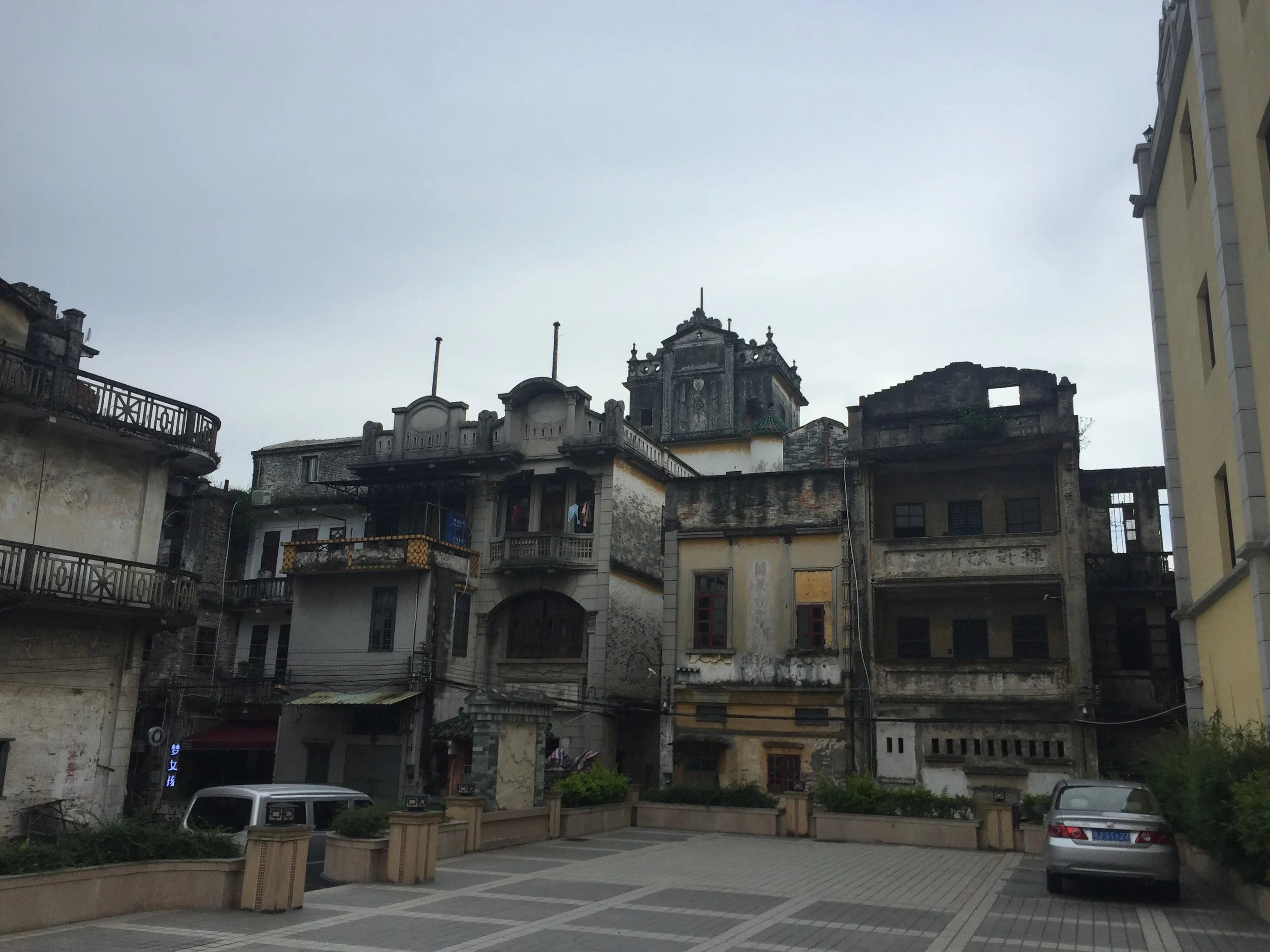
Chikan (often spelled “Chikan” or “Chek Khan” in older usage) is one of Kaiping’s historic commercial cores, with roots going back centuries and a peak period as a market town before mid-20th-century decline. When I first saw it years ago, it carried that particular atmosphere of places caught between abandonment and rebirth with the facades crumbling around the dirty riverfront vendors.
Then came the modern state response: restoration, investment, redevelopment. This has been very common in modern China. When governments allocate massive budgets to revive heritage districts, they are making operational decisions about:
identity branding
tourism economics
real estate value
political legitimacy
cultural narrative control
Even a visitor who “just walks around” is walking through a strategic project.
A practical question for leaders and city planners is not “Is restoration good or bad?” That question is too simplistic. A more disciplined question is: What does the restoration optimize for?
Local community continuity?
Visitor spend?
National image?
Developer returns?
Heritage integrity?
You can often tell by what gets restored first: facades or functions or image or livelihoods.
Indeed, Kaiping’s restoration efforts invite a broader reflection about modern Asia: heritage is increasingly treated as economic infrastructure. Not just memory, but revenue logic. If you want a clean lens for this, it’s here. Cultural memory infrastructure refers to physical and social structures that preserve identity, transmit norms, and stabilize a community across change
The Kaiping Loop: If I had to distill Kaiping into a model that leaders, educators, and global professionals can apply, it would look like this:
1) Exposure
Individuals leave, work, struggle, learn, and adopt new standards.
2) Return
Money, ideas, and identity come back. Sometimes physically, sometimes through remittances and social influence.
3) Reinforcement
Return is stabilized through structures: buildings, institutions, family halls, business ventures.
4) Reordering
Local norms shift. Status markers change. Security strategies evolve. The community updates its operating rules.
This loop plays out in immigrant communities worldwide, but Kaiping is special because you can literally walk through it.

If you lead cross-cultural teams, here is something to remember. No one returns the same. Not the person. Not the organization. Time abroad alters standards. It recalibrates trust, speed, hierarchy, even what “professional” feels like. When those returnees walk back into the system, friction is inevitable. Posters about open-mindedness won’t fix it. Structure will. You need translation mechanisms. Mentorship. Shared decision logic. Cultural onboarding that works both ways. Integration is engineered, not wished into existence.
Entrepreneurs across Asia should pay attention to something equally subtle. Your space is strategy. The layout of your office, the flow of your storefront, the way your digital platform moves a customer from curiosity to commitment. All of it speaks. Architecture, physical or virtual, announces your priorities long before your marketing copy does. If your environment tells the wrong story, no branding exercise will save it.
For educators, Kaiping is a gift. You can teach systems thinking without a single equation. Migration, capital, risk, identity, continuity. It’s all there, standing in the fields. Students may forget the theory slide, but like me, they rarely forget a tower.
And for those of us who live abroad, the deeper tension is identity layering (forget culture shock, that’s surface level). Your internal “normal” shifts and you bring those altered standards into every room afterward. Which parts of your new baseline represent genuine improvement, and which are simply context?
Kaiping’s lesson is simple but demanding: take global exposure and convert it into local strength without losing coherence.
If you want to go deeper into the ideas behind this essay:
If Kaiping is approached as a travel stop, it becomes a quick loop of photos and facts. When you stand beneath them, you can feel the logic that produced them. A leader’s job is not to eliminate uncertainty. A leader’s job is to design responses that keep people safe, coherent, and capable.
Kaiping did that in plain sight. And it is still standing.
FAQ:
Are the Diaolou mainly Western or Chinese in style?
They are hybrid. Their form reflects returning overseas Chinese blending external influences with local construction needs and defensive priorities.
What is the core “systems lesson” of Kaiping?
Migration and return reshape local systems. Capital and ideas come back, and communities stabilize the change through structures and institutions.
Why are these towers defensible structures?
They were built in contexts of insecurity and designed for surveillance and protection, with thick walls, height, and openings suited for defense.
How does Kaiping connect to modern leadership?
It shows how groups translate uncertainty into design choices, how identity is reinforced through structure, and how continuity is protected during change.
