Your Employees May Not Need Another English Class
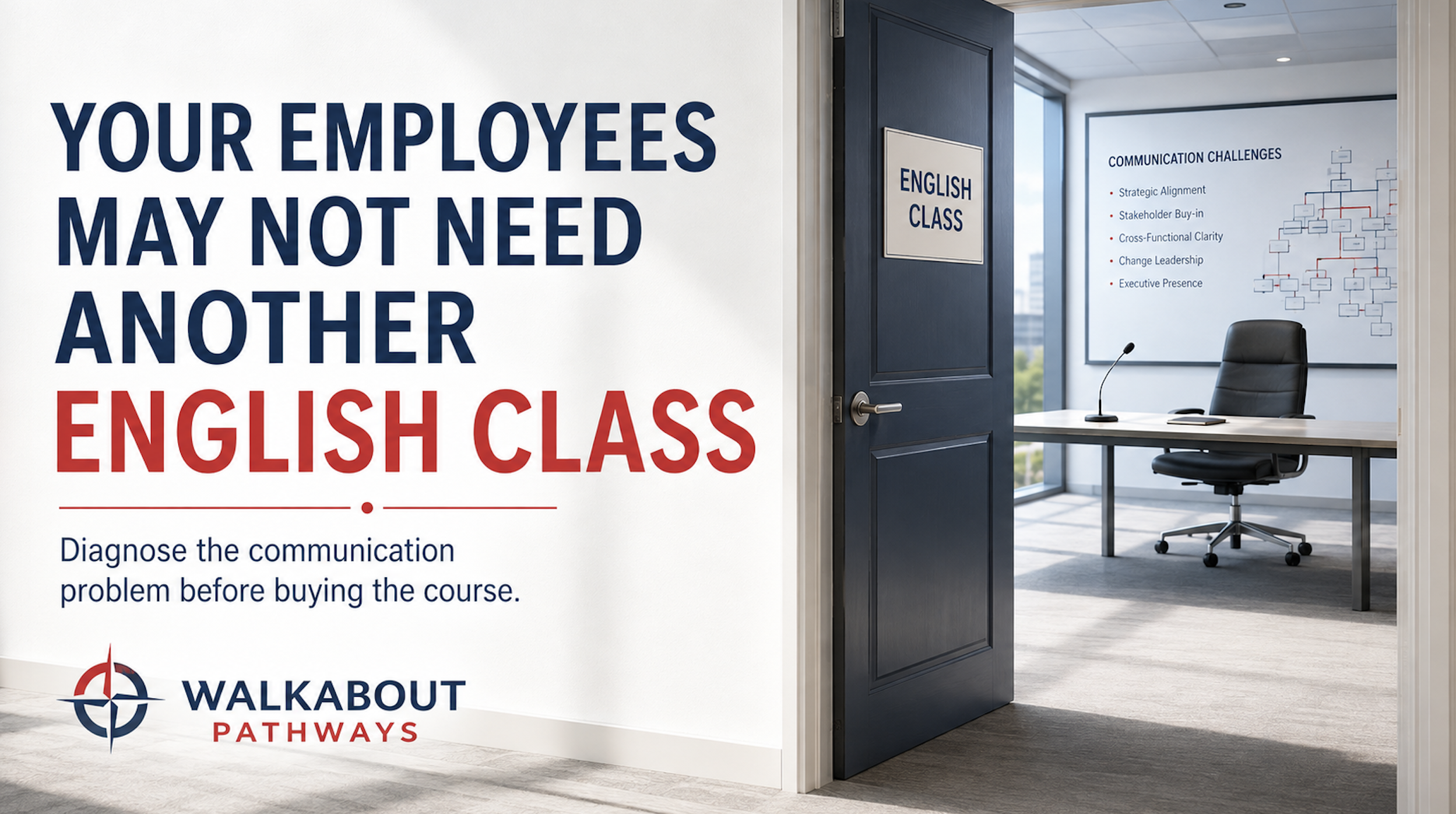
For years, I have watched companies respond to communication problems in the same dependable way.
A manager tells human resources that the team needs better English. HR contacts a language provider. Employees take a placement test, receive a level, and begin another course in grammar, vocabulary, pronunciation, email writing, presentation phrases, or Business English.
The training may be good and the teacher may be excellent and the employees may enjoy the classes. Then they return to work and continue struggling with many of the same situations.
They hesitate during meetings. They bury simple ideas beneath crowded slides. They avoid difficult conversations. They speak comfortably with colleagues but become silent when a senior manager enters the room. They understand an international client’s question, yet answer so cautiously that nobody is quite sure what they think.
Sometimes the problem is English. Sometimes it is not.
I have taught and trained people in the United States, China, and Vietnam. Some genuinely needed stronger language foundations. They lacked the vocabulary required for their roles, struggled to understand conversations, or made errors that prevented other people from following them. English instruction gave them access to work, study, and relationships that had previously been difficult.
Other professionals already had enough English to perform their jobs. They could read reports, write acceptable emails, discuss technical matters, and follow meetings. Some had studied English for most of their lives. Their certificates were impressive enough to wallpaper a small office.
Yet something changed when professional pressure entered the room. Ask them to present a recommendation to senior management, challenge a colleague politely, explain a complex idea without preparation, or answer an unexpected question in public, and the language they knew became harder to use.
The English was there. The ability to use it effectively in that moment was not. That distinction matters because companies often purchase language training when the employee needs a different kind of development.
“Better English” can mean almost anything
Imagine a department manager saying, “My team needs to improve its English.”
What does that actually mean?
Perhaps employees cannot understand overseas customers. Perhaps their writing causes confusion. Perhaps they lack technical vocabulary or make frequent errors that affect meaning. Those are language problems, and language instruction is an appropriate response.
The manager may also mean that employees rarely contribute during meetings. Their presentations are difficult to follow. They appear nervous around foreign colleagues. They avoid disagreement, speak without a clear point, or depend so heavily on notes that the notes seem to be delivering the presentation themselves.
Those are different problems.
A technical specialist may know the subject better than anyone else in the room but struggle to explain it in a logical order. A supervisor may use accurate English yet sound uncertain when giving direction. A fluent employee may talk for ten minutes when two would have been generous. Another may communicate well in informal settings but freeze when speaking to executives.
All four can be placed beneath the same label: poor English.
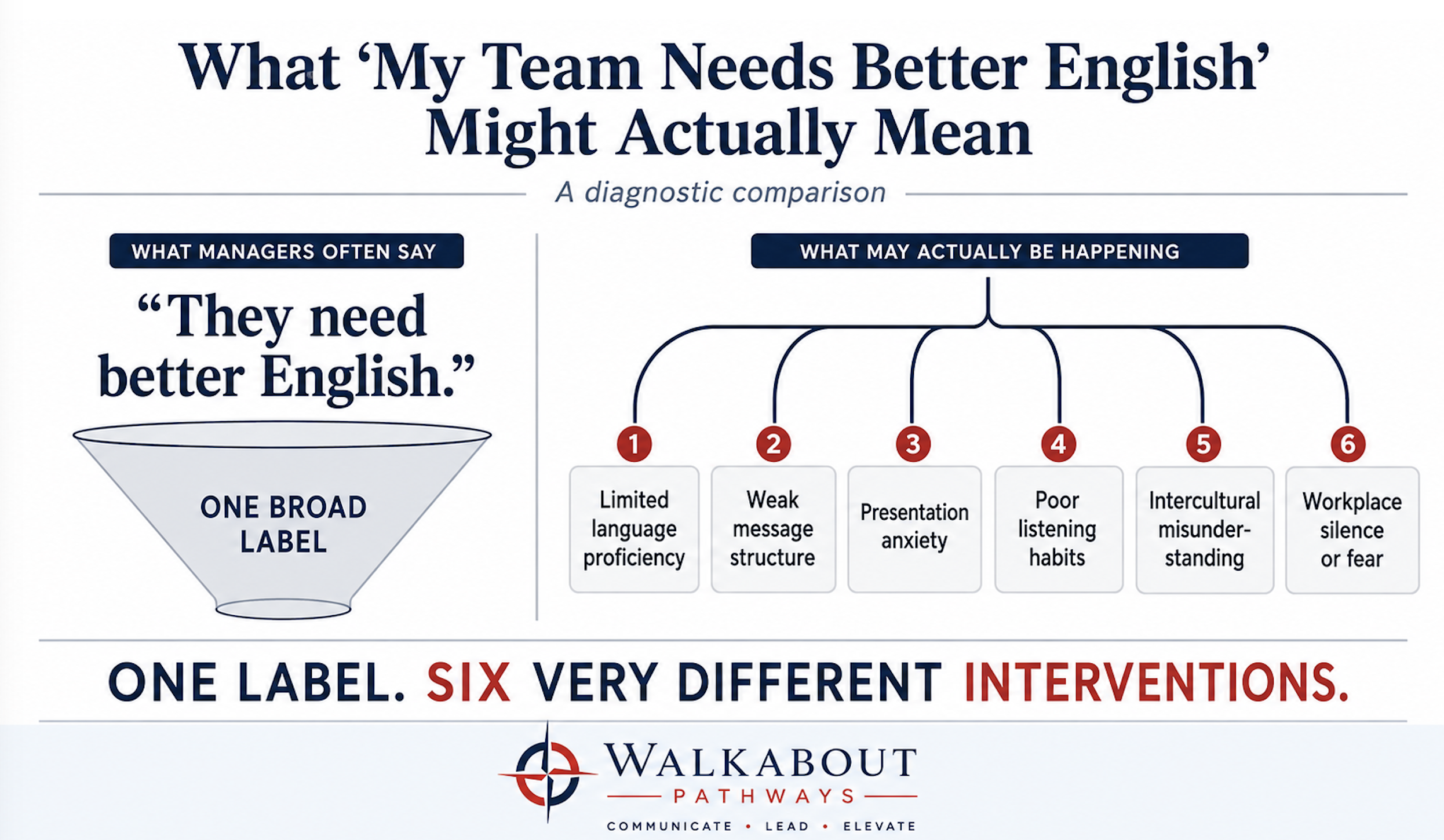
Once that happens, the company begins solving the label instead of investigating the behavior.
The standard process is administratively convenient. Participants complete a placement test, join a group at roughly the same proficiency level, and move through a common curriculum. Grammar, listening, vocabulary, and general speaking ability can all be assessed this way.
What the test may reveal far less about is how someone leads a meeting, handles resistance, organizes a recommendation, listens under pressure, reads an audience, or adapts a message when the conversation takes an unexpected turn. It measures what people know about English. It does not always show what they can do with English at work.
Start with the job, not the catalogue
English for Specific Purposes has argued for decades that useful instruction begins with the situations learners actually face. Researchers including Hutchinson and Waters, Dudley-Evans and St John, and Helen Basturkmen have emphasized target tasks, workplace demands, and careful needs analysis.
The principle is wonderfully unglamorous: Find out what people need to do before deciding what to teach them.
Corporate training often begins elsewhere. Providers ask how many employees will attend, how many hours the company wants to purchase, and what level the participants have reached. Those questions are necessary, but they rarely reveal the whole problem.
Far less attention may be given to observing a meeting, reviewing an actual presentation, speaking with managers, examining client interactions, or identifying the moments when communication breaks down.
That is how a nervous presenter ends up studying verb tenses. It is how a manager who struggles to give feedback receives a vocabulary list about negotiation. It is how an employee with understandable pronunciation spends twenty hours trying to sound more American while continuing to deliver presentations with no visible point.
There is nothing inherently wrong with the course. It may simply be unrelated to the problem causing the most damage.
A useful umbrella still performs poorly during an electrical outage.

Communication is larger than language
English proficiency and professional communication overlap, but they are not identical. Language gives people words, grammar, and structures. Communication requires judgement about how to use them.
A professional must decide what the audience needs to know, what can be left out, which point should come first, and how directly an opinion should be expressed. They need to listen, respond, clarify, disagree, and notice when the person across the table has misunderstood them. They also need to cope when the discussion leaves the script, which tends to happen just after the speaker has begun feeling safe.
Grammar cannot organize an argument by itself. Vocabulary does not make a person concise. Clear pronunciation does little for someone who never pauses long enough for another person to speak.
Fluent English speakers can still be dreadful communicators. Native speakers prove this in offices every day, often with extraordinary self-belief.
Communication researchers have long recognized this difference. Dell Hymes introduced the idea of communicative competence partly to challenge the view that knowing a language was mainly about mastering its formal rules. Later work by Michael Canale and Merrill Swain included sociolinguistic, discourse, and strategic competence.
In ordinary workplace terms, successful communication involves knowing what fits the situation, how ideas connect, and what to do when understanding begins to collapse. Workplaces add hierarchy, culture, relationships, history, and risk.
A Vietnamese employee and an American manager may understand every word in the same conversation while interpreting the exchange differently. The manager asks whether anyone disagrees. Nobody speaks. The manager assumes there is agreement. The employees may be thinking that disagreement would embarrass the manager, harm the relationship, or make them appear troublesome. The vocabulary worked perfectly, but the meaning did not.
I have seen professionals with modest English communicate exceptionally well because they paid attention, prepared carefully, asked useful questions, and genuinely listened. I have also seen fluent speakers create confusion because they spoke too much and noticed too little.
Professional communication is less like a ladder from poor English to fluent English. It is closer to a collection of abilities that develop at different speeds.
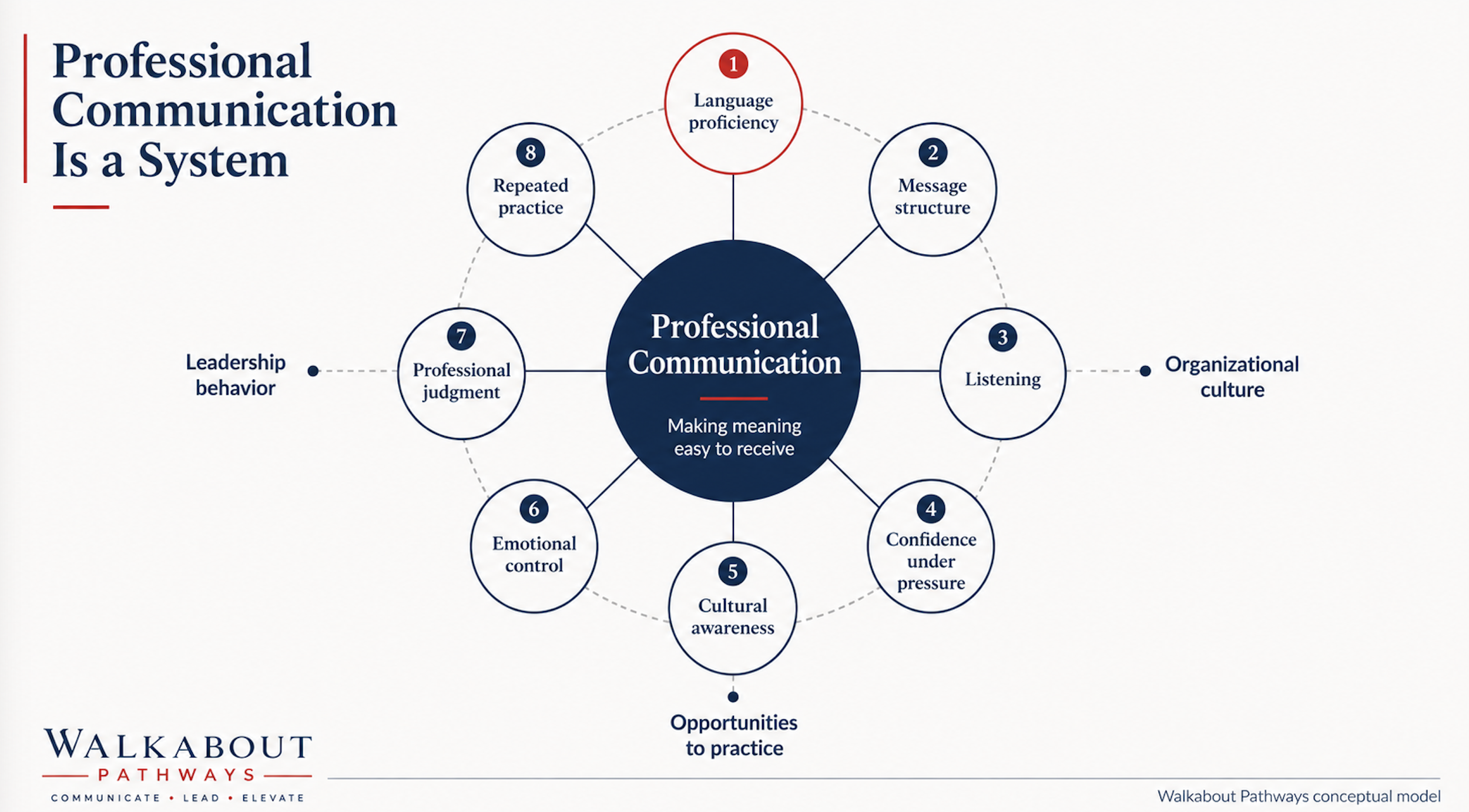
One employee needs grammar. Another needs a clearer structure. Someone else needs practice managing nerves. A manager may need to listen without interrupting. A technically excellent team member may need coaching on how to explain ideas to non-specialists. Putting all of them in the same class may be efficient for scheduling. It is less convincing as a development plan.
Why good training often disappears by Monday
Even relevant training can fail once employees return to work. Research on training transfer, including the influential work of Timothy Baldwin and Kevin Ford, has shown that learning depends on more than what happens during the course. Learner characteristics matter. Training design matters. The workplace itself matters enormously.
Employees may participate well during a workshop. They complete the activities, contribute to discussions, and leave with useful techniques. Everyone poses for the certificate photograph. The trainer goes home happy.
Then Monday arrives.
Managers interrupt as they always have. Presenters return to reading from slides. Junior employees avoid difficult questions. Nobody watches for the new behavior, and nobody helps when old habits return. The training took place, but the workplace stayed the same.

A facilitator can teach employees how to contribute during meetings. If senior leaders regularly dismiss questions, remaining quiet may still be the smartest response. A trainer can show managers how to hold productive feedback conversations. The skill will fade quickly if nobody expects those conversations to happen.
Communication development cannot be separated from leadership behavior. Employees learn from the room around them. They notice who gets interrupted, whose mistakes are forgiven, and whether speaking honestly creates opportunity or trouble.
Confidence is often misunderstood for the same reason. Managers tell employees to be more confident, as though confidence were a switch hidden behind the left ear.
In practice, professional confidence often grows through preparation, a clearer message, repeated exposure, useful feedback, and a few successful experiences. A nervous presenter may need English support, but they may also need help organizing ideas, handling notes, answering questions, and recovering when something goes wrong.
Teaching them to begin with “Today I would like to talk about” improves one sentence, but the presentation still has another twenty minutes to survive.
Language centers are still valuable
None of this is an argument against English education. Good language teaching changes lives, expands career options, supports international study, and allows people to participate in conversations that would otherwise remain closed to them.
Vietnam has a substantial need for high-quality English instruction. Students, graduates, early-career professionals, and experienced managers may all have language gaps that deserve serious attention.
The problem appears when English training becomes the automatic response to every workplace communication concern. Companies understand how to purchase a forty-hour language course. It has a timetable, a syllabus, levels, lesson plans, and a price per participant. It is familiar and easy to compare.
A proper communication diagnosis is less tidy. It may require interviews, observation, samples of real workplace material, input from managers, and different responses for employees within the same team. One person may need language lessons. Another may benefit from presentation coaching. A third may require simulated client conversations. The team leader may need to change the way meetings are conducted.
That is harder to package than one teacher, one textbook, and fifteen people moving through Unit Six together.
Language providers are also frequently expected to deliver leadership development, confidence coaching, presentation training, intercultural competence, and workplace change beneath the generous umbrella of Business English. The expectations become enormous, but the intervention remains narrow and everyone is surprised when the results are modest.
Begin with the behavior
A better process starts with a few practical questions.
· Where does communication fail?
· Does it happen in meetings, presentations, client calls, written messages, management conversations, or international teamwork?
· Who struggles, and under what conditions?
· What can employees already do well?
· What would improvement look like in observable terms?
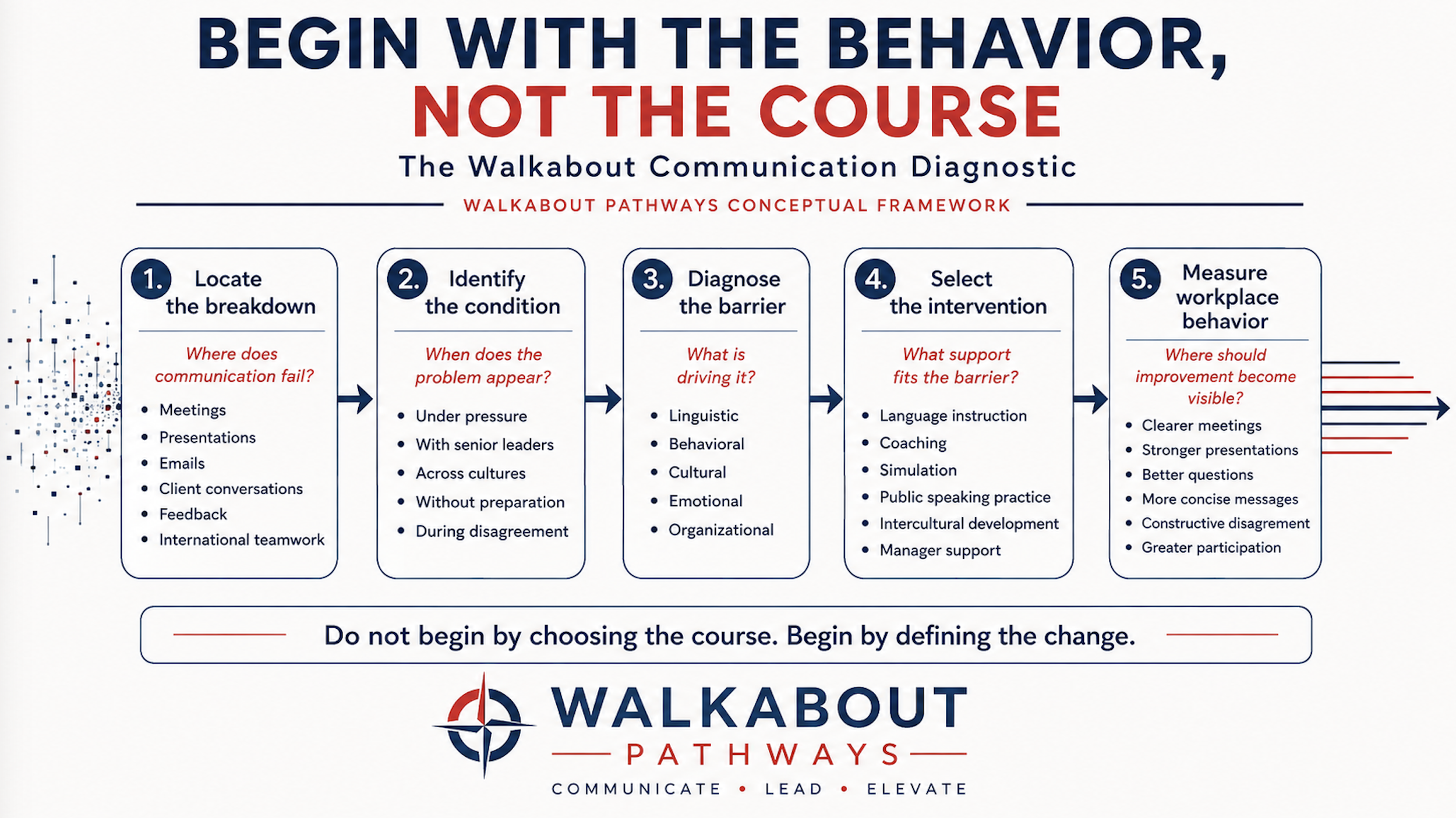
The last question is especially important. “More confidence” is vague. “Contributes at least once during weekly team meetings” is visible. “Better presentations” tells us little. “Explains the recommendation, evidence, and next action within five minutes” gives the employee and manager something they can work with. The barrier may be linguistic, behavioral, cultural, emotional, organizational, or some untidy combination of them.
A manager might lack the English vocabulary needed for detailed feedback while also avoiding the conversation because conflict feels uncomfortable. A presenter may make several grammatical mistakes and still be perfectly understandable, while weak organization causes the audience to miss the main recommendation.
Once the problem is clearer, the intervention becomes easier to choose.
Some employees need English classes. Others need coaching, practice, workplace observation, manager support, or realistic simulations built around their own responsibilities. Many need a combination delivered over time.
This diagnostic approach sits at the center of the work we are developing through Walkabout Pathways. We begin by examining how people communicate now, what their roles demand, and where the gap appears between what they know and what they can consistently do.
The company can then stop measuring success through attendance hours and satisfaction forms alone. Progress becomes visible in the workplace: clearer meetings, shorter explanations, stronger presentations, more productive disagreement, and better conversations with clients and colleagues.
English may be central to that progress, but it simply may not be the entire problem.
Your employees may need another English class. They may also need clearer thinking, better practice, individual feedback, stronger management, or a workplace where using their voice feels worthwhile. Before choosing the course, discover which problem you are actually trying to solve.
About the Author
Paul Allen Benavides is a university lecturer in business and media, corporate trainer, speaker, MC, author, YouTuber, and podcast host. He is the co-founder of Walkabout Pathways. His professional work focuses on communication, public speaking, leadership presence, workplace learning, and cross-cultural collaboration. His doctoral research examines trust, professional relationships, and value creation within place-based international business ecosystems.
