The Corporate Training Diagnosis Is Often Wrong
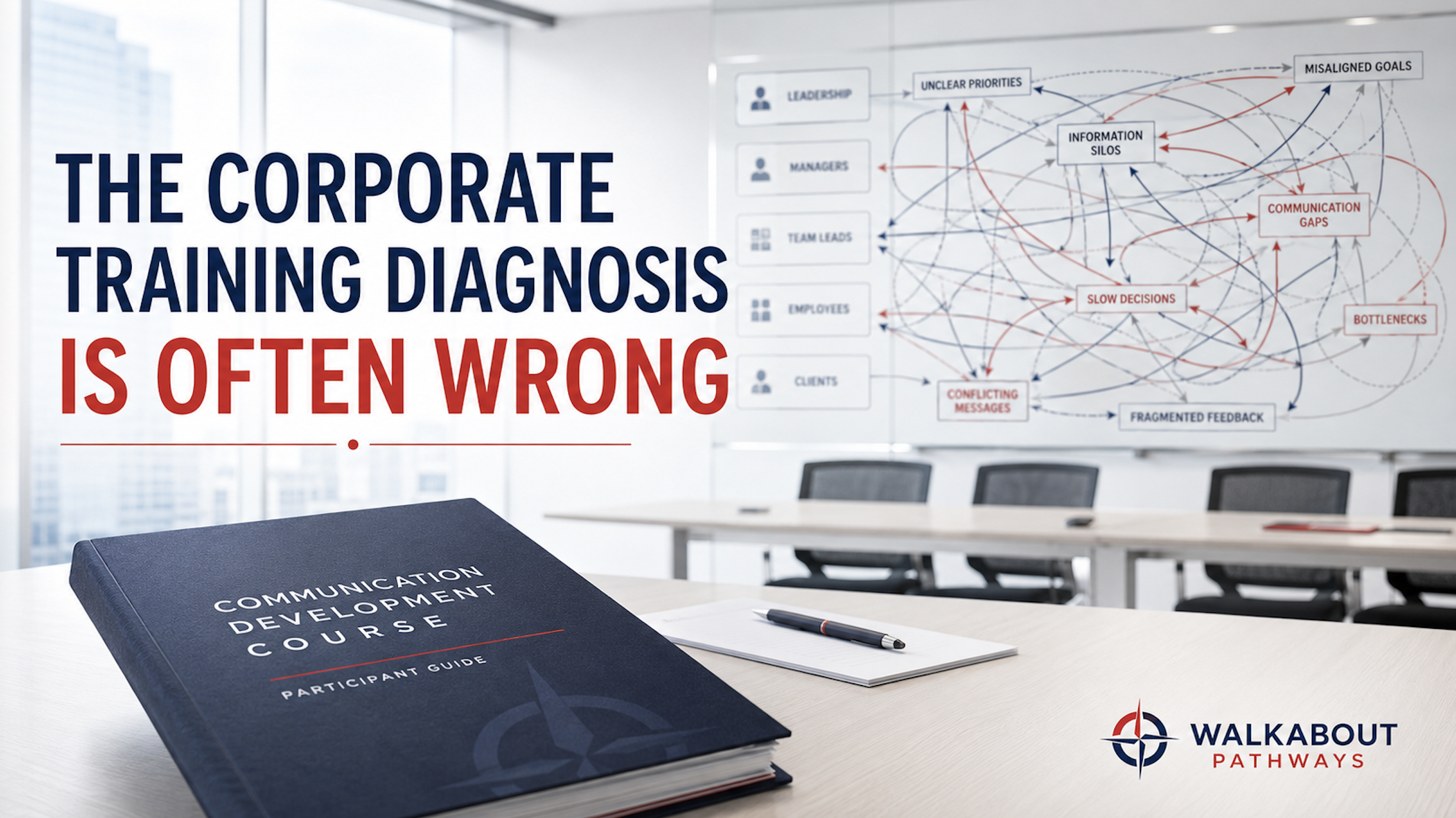
Several years ago, I was asked to teach a group of employees at a local technology firm in Da Nang, Vietnam who had been sent for Business English training. The company’s concern sounded straightforward enough: the staff needed to communicate more effectively in an international environment. That description could have covered a wide range of needs, from vocabulary and listening comprehension to writing, presentation skills, or confidence.
Once I met the participants, the picture became far less uniform. A few employees genuinely needed stronger English and would clearly benefit from language instruction. Others could communicate comfortably but became anxious when speaking in front of colleagues. Some understood technical discussions perfectly well yet struggled to explain their ideas in a logical sequence. One or two had no shortage of confidence, but they rarely listened long enough to understand what anyone else was saying.
All of them had entered the same classroom because the organization had given them the same diagnosis: they needed better English. The course had already been selected, the hours purchased, and the employees grouped before anyone had seriously examined why their communication was breaking down in the first place.
I have seen variations of this pattern repeatedly in professional education. “Employees struggle to communicate” becomes Business English. “Managers lack confidence” becomes presentation training. “Teams are not collaborating” becomes a teamwork workshop. “Supervisors avoid difficult conversations” becomes a leadership course. Each response sounds reasonable, and sometimes it is exactly right, but organizations can move from a visible symptom to a familiar solution with remarkable speed.
Training is then commissioned, delivered, evaluated, photographed, and filed away. Participants complete feedback forms, perhaps everyone poses with certificates, and the organization can point to a completed development initiative. Months later, if the original behavior has barely changed, the facilitator may be blamed, or employees may be described as unmotivated, or another course may be commissioned. The possibility that the organization purchased the wrong intervention receives much less attention.
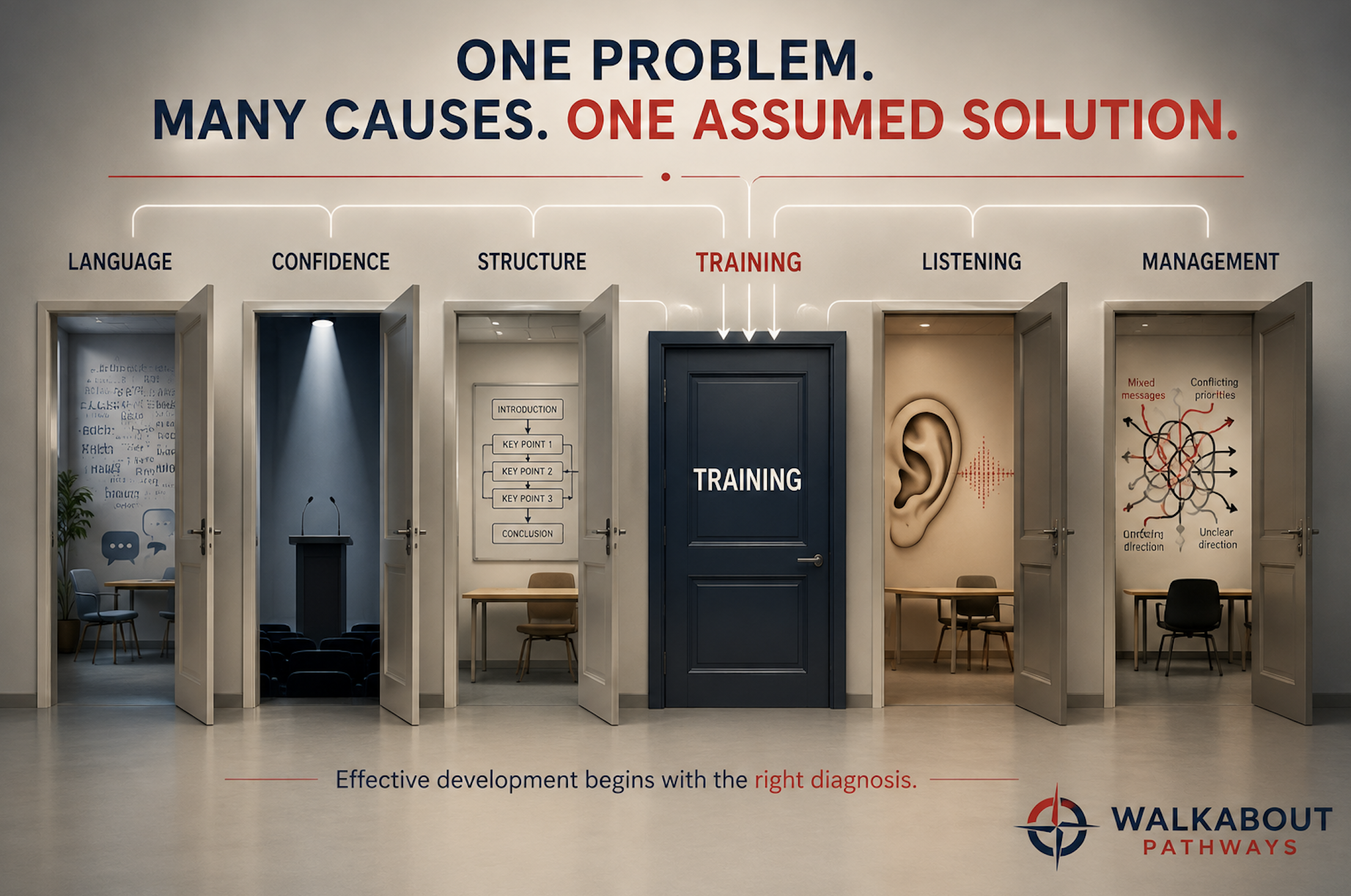
The course is often chosen before the problem is understood
By the time a training provider receives an inquiry, many important decisions may already have been made. A company asks for twenty hours of Business English, a two-day leadership program, or a half-day communication workshop for fifteen managers. The provider is expected to respond with a curriculum, timetable, facilitator profile, and price.
From a commercial perspective, there is an obvious incentive to answer the request exactly as it arrives. If the client asks for presentation training, offer presentation training. If the company asks for Business English, provide Business English. A provider who instead wants to interview managers, observe employees, review job requirements, or understand where performance actually fails may be doing something professionally responsible, but they may also appear slower, more expensive, or less convenient than the competitor who sends a polished proposal the same afternoon.
This creates an awkward incentive for both sides. Organizations want training to be easy to purchase, while providers want services to be easy to sell. Diagnosis adds time and uncertainty. It can also uncover problems that do not fit neatly into a standard course.
Human resources teams are often caught in the middle. A manager may report that employees need “more confidence,” “better communication,” or “stronger leadership skills,” leaving HR to convert broad descriptions into something that can be budgeted, scheduled, and purchased. A course provides a clean answer. A deeper investigation may reveal that different employees need different forms of development, that the problem is partly caused by managers or internal systems, or that training alone will do very little.
Those findings complicate procurement, but they also make better decisions possible. Research on training and organizational outcomes has generally found that employee development can contribute to performance, yet the relationship depends heavily on context and alignment with organizational needs. Training creates value when the intervention fits the problem, the work, and the environment in which people are expected to perform.
A beautifully delivered course can still be the wrong course.
Symptoms are clues, not diagnoses
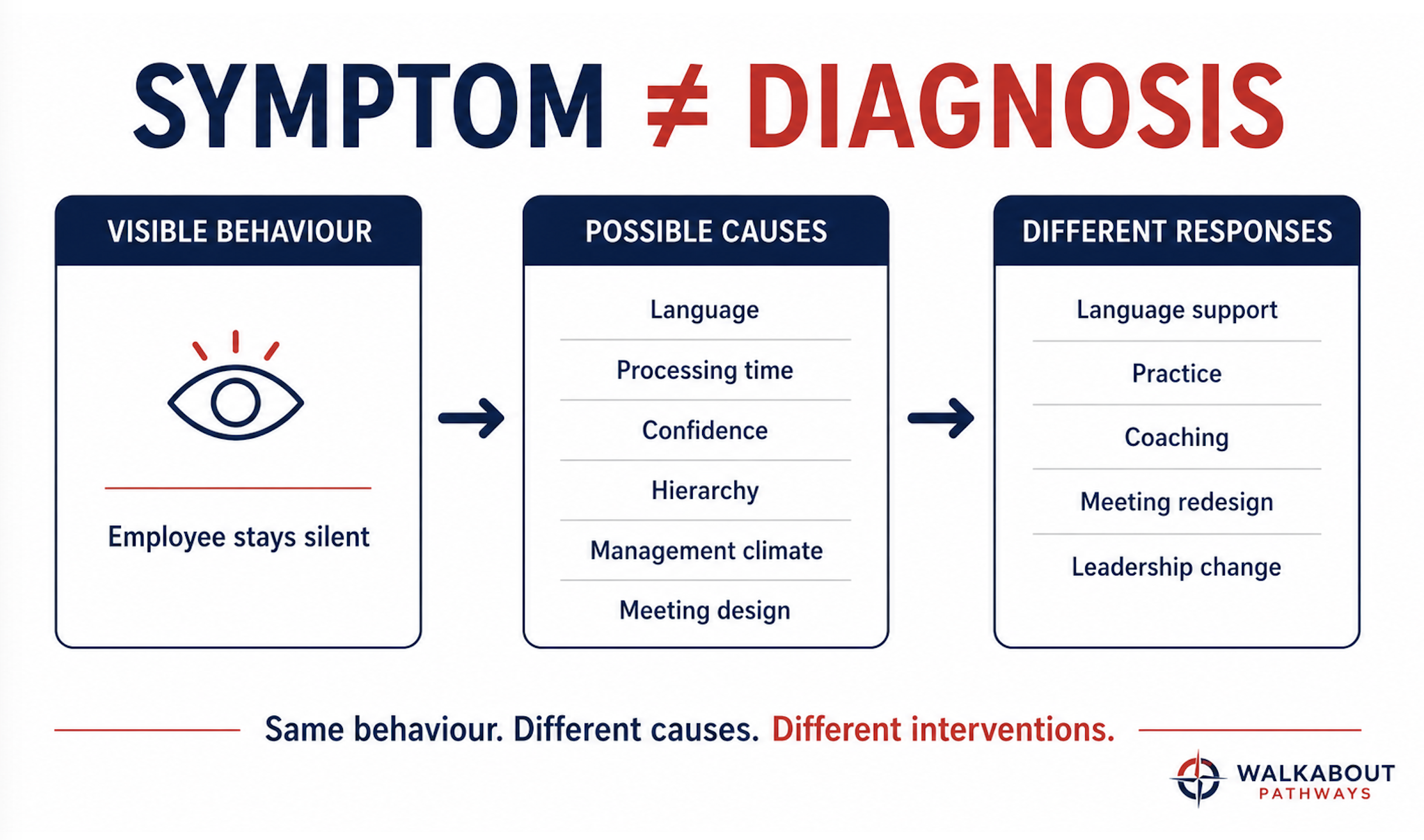
Consider an employee who rarely speaks during meetings. The obvious explanation may be that the employee lacks confidence, but several other possibilities are equally plausible. Their English may make it difficult to form a complex response quickly. They may understand the discussion but need more time to organize their thoughts. They may fear making mistakes in front of senior colleagues, or they may have learned through experience that disagreement is unwelcome. They may come from a professional environment where junior employees are expected to wait until invited to speak.
There is another possibility that receives less sympathy: the meeting may simply be badly run, and the employee may have concluded that contributing will make no difference.
From the outside, each version looks similar because the employee remains silent. The causes, however, point to very different interventions. One person may benefit from language support, another from structured speaking practice, and someone else from gradual exposure to more demanding situations. In another team, the more useful intervention may be clearer meeting protocols or a change in management behavior.
This is why visible behavior should begin the investigation rather than end it. A symptom tells us where to look, but it does not automatically tell us what to buy.
Surveys, interviews, and placement tests can all provide useful information, but they can also reproduce the assumptions that created the original diagnosis. Employees may request English because that is the category they know. Managers may say staff lack initiative without examining what happens when employees actually take initiative. A proficiency test may show that someone has intermediate English without showing whether that level prevents them from performing their job successfully.
A stronger diagnosis moves away from broad labels and asks a more practical question: what is preventing the required performance from happening?
A performance gap is not automatically a training need
This distinction sounds simple, but it changes the logic of training decisions. A performance gap exists whenever actual performance falls below what the organization expects. Training is useful when that gap is caused by something people can learn, but many performance problems are produced by factors that a classroom cannot fix.
Employees may lack information, authority, time, equipment, clear expectations, or useful feedback. Processes may be poorly designed, managers may send conflicting instructions, and incentives may reward one behavior while leaders publicly ask for another. In such cases, the employee may appear to have a skill problem when the larger obstacle sits somewhere else in the organization.
Consider a hotel employee who appears weak at handling guest complaints. Limited English may genuinely be part of the problem, particularly if the employee struggles to understand the guest or explain available options. But imagine that the same employee understands the complaint perfectly and is required to seek a manager’s approval before resolving even a minor issue. Teaching twenty new service phrases will not remove the delay created by the approval process.
The same logic applies to management development. A supervisor may avoid difficult feedback because they do not know how to structure the conversation, in which case coaching could be very useful. But they may also avoid feedback because performance standards are vague, senior leadership discourages conflict, or the company has never created an expectation that developmental conversations should occur.
A sales employee may struggle with presentations because they need help with message structure and delivery. They may also be working with an unclear value proposition or poor data. Presentation coaching can improve how the message is delivered, but it cannot create a convincing business case from weak information.
Training should therefore never become a respectable substitute for management. Sending people to a course can place the problem safely inside the employee while leaving leadership habits, systems, and job design untouched. The organization appears to be taking action without disturbing the conditions that may be producing the behavior in the first place.
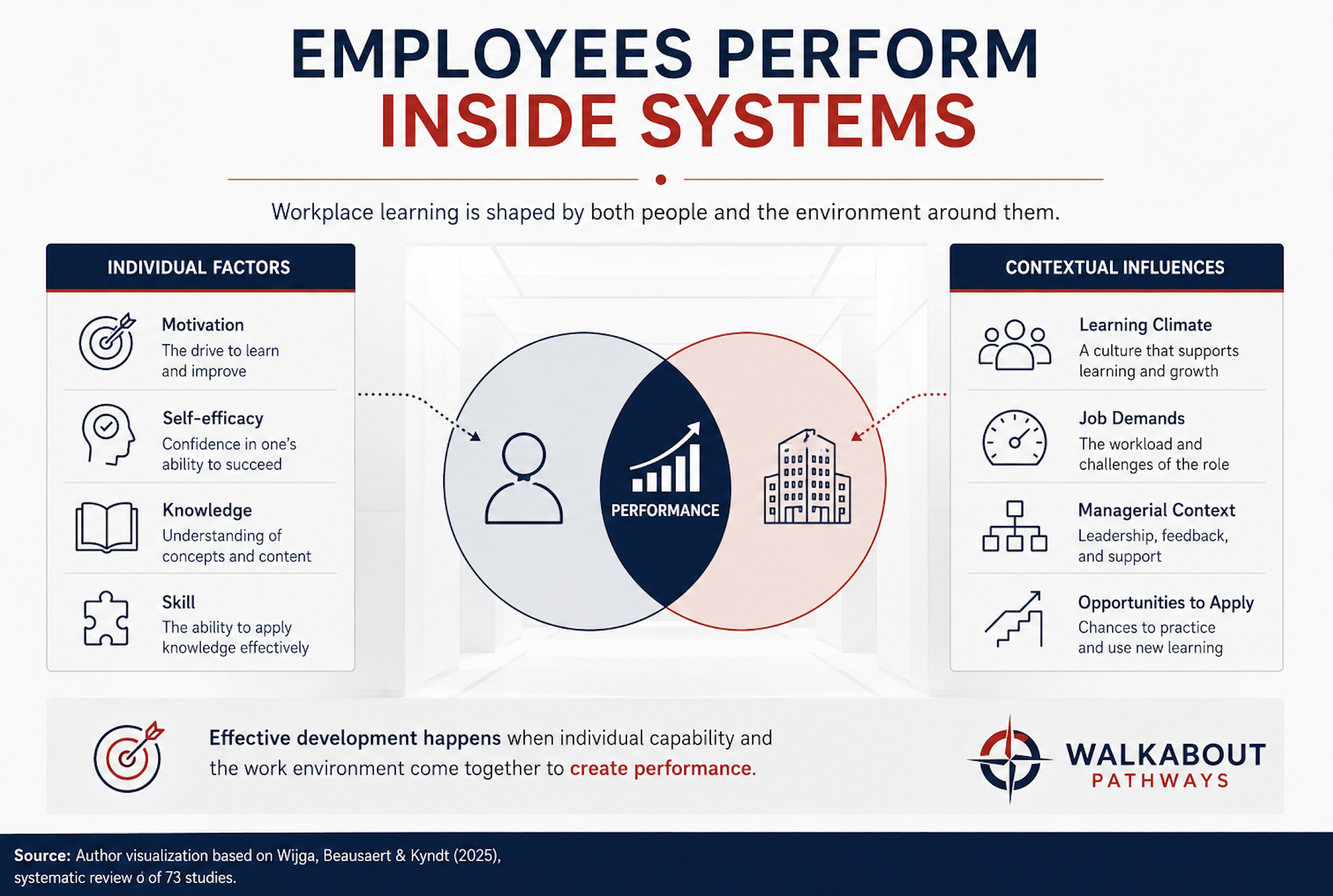
Recent research on workplace learning supports this broader perspective. A systematic review of 73 studies found that learning at work is shaped by both individual factors, including motivation and self-efficacy, and contextual influences such as learning climate and job demands. Employees do not perform inside training rooms; but rather inside systems. Any serious diagnosis needs to examine both.
Define what good performance actually looks like
One of the simplest ways to improve training decisions is to stop beginning with vague objectives. “Improve communication” is too broad to guide a useful intervention. “Employees should be able to present a recommendation to regional management in ten minutes, explain the evidence supporting it, and respond to questions without reading from a script” provides something observable.
The same applies to confidence. “Build confidence” sounds positive, but it gives little guidance about what should change. “Front-line supervisors should be able to raise a performance concern directly, explain the expected standard, and invite the employee to respond” describes behavior that can be practiced and observed.
Even “improve English” becomes more useful when it is connected to real tasks. “Customer-service employees should be able to understand common guest complaints, clarify missing information, explain available options, and escalate appropriately” gives the organization a far clearer target than simply moving employees from one proficiency level to another.
Once the expected performance is defined, the organization can examine current behavior and the conditions surrounding it. Managers can describe what employees are expected to do and where they believe performance breaks down. Employees can explain the situations they find difficult, the support they receive, and the obstacles managers may not see. Customers, colleagues, or partner teams may reveal another side of the same issue.
These perspectives should not be expected to agree. A manager may believe employees lack initiative, while employees remember what happened the last time someone challenged a decision. Senior leaders may describe the culture as open, while junior staff have become highly skilled at identifying the situations in which honesty carries unnecessary risk.
Those contradictions are useful because they show where assumptions and experience diverge. Interviews can surface them, but observation often provides an even clearer view of what is happening.
Workplace observation also reveals the conditions around performance. Who speaks first? Who gets interrupted? What happens when somebody makes a mistake? How are questions handled? Which tasks create hesitation, and which seem easy? These details rarely appear in a placement test, but they often explain why performance succeeds in one situation and collapses in another.
The role matters
Employees working in the same organization may need completely different communication abilities. A front-desk employee, engineer, sales manager, supervisor, and chief executive may all work in an international environment, but the communication demands of their roles differ considerably.
A supervisor may need to delegate, coach, give feedback, and manage disagreement. A technical specialist may need to explain complicated information to people without a technical background. A senior leader may need to speak publicly, influence external stakeholders, and create clarity during uncertainty.
This idea has long been central to English for Specific Purposes, where language development is connected to the communication demands of particular roles and settings rather than treated as general proficiency detached from context. The same principle applies beyond language. People should practice the decisions, conversations, pressures, and communication situations they are expected to handle at work.
Calling all of these needs “communication training” may be administratively convenient, but it hides important differences in what people actually need to learn and practice.
Why standard courses remain attractive
If deeper diagnosis leads to better decisions, it is reasonable to ask why standardized training remains so common. The answer is largely practical: standardization is easier.
One provider, one curriculum, one schedule, and one budget are simple to manage. Employees can be grouped by department or proficiency level, attendance can be recorded, and completion can be measured. Training companies can assign facilitators, reuse established material, and deliver programs at predictable cost.
Personalization introduces friction. It requires more information, more planning, and sometimes several development pathways inside the same organization. A proper assessment might reveal that some employees need language instruction, others need coaching, and a few do not need formal training at all. That final possibility is rarely the favorite conclusion of a provider whose revenue depends on selling courses.
There is also something reassuring about visible activity. Leaders can see employees attending training, HR can count hours, participants can complete surveys, and certificates can be distributed. A diagnostic process may produce fewer photographs, but it may uncover more uncomfortable truths.
The organization may discover that managers are part of the problem. It may find that employees have no opportunity to practice new skills because workloads are unreasonable. It may learn that the behavior everyone wants has never been clearly defined or consistently reinforced.
A generic program avoids some of those discoveries. It creates movement, although movement and progress are not always the same thing.
Begin with evidence, then choose the intervention
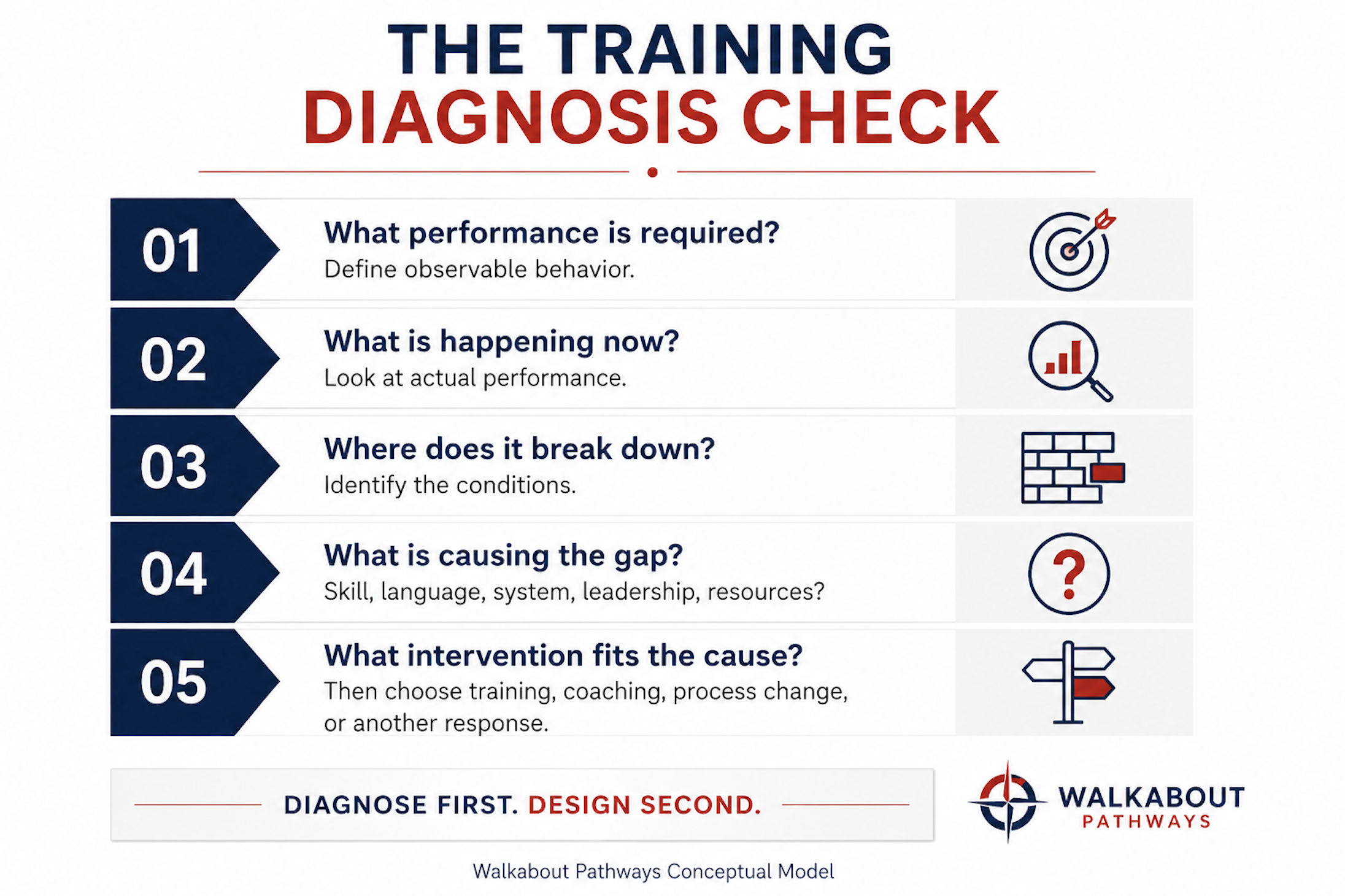
A stronger process reverses the usual sequence. Rather than beginning with the course title, the organization begins with the business or performance concern. It identifies where the behavior breaks down, examines the conditions around it, speaks with the people involved, and observes the work where possible.
From there, it becomes easier to decide whether the barrier involves knowledge, skill, language, confidence, culture, leadership, process, resources, or some combination of them. Only then does the organization choose the intervention.
This also changes how development should be evaluated. Instead of beginning with whether participants enjoyed the workshop, the organization can return to the behavior that triggered the investment. Are meetings clearer? Are managers handling feedback more effectively? Can employees deal with international clients with greater independence? Have presentations become easier to follow? Is communication leading to better decisions?
Participant satisfaction still matters because people learn more effectively when they feel engaged and respected, but enjoyment is evidence of a positive learning experience rather than proof of improved performance. A participant can enjoy a workshop enormously and change very little. Another may find a coaching session demanding and uncomfortable yet emerge with a skill that changes how they work.
The evaluation therefore needs to return to the original diagnosis. What was supposed to change, and did it?
At Walkabout Pathways, this is why we begin with people and work rather than with a catalogue of courses. Interviews, observation, and role analysis help us understand what employees already do, what their jobs require, and where the gap actually appears. From there, development can be built around the performance problem rather than around a predetermined format.
Sometimes that diagnosis will lead to a structured program. Sometimes it will lead to language support, presentation practice, leadership communication, coaching, or cross-cultural development. The format matters less than the match between the intervention and the problem.
Companies should continue investing in employee development. Work changes, expectations change, and professionals need opportunities to grow. Much of the value of that investment, however, is determined before the facilitator ever enters the room.
The most expensive training is not always the program with the highest fee. It is the program that consumes time, money, and attention while solving the wrong problem. Before purchasing the next course, organizations would benefit from asking a harder question: What is actually preventing our people from performing as required?
The answer may lead to training. It may also lead somewhere more useful.
About the Author
Paul Allen Benavides is a university lecturer in business and media, corporate trainer, speaker, MC, author, YouTuber, and podcast host. He is the co-founder of Walkabout Pathways. His professional work focuses on communication, public speaking, leadership presence, workplace learning, and cross-cultural collaboration. His doctoral research examines trust, professional relationships, and value creation within place-based international business ecosystems.
